

Connect With Us
Click below to connect with me and learn about latest from your industry.
Saving a 1031 Exchange Closing
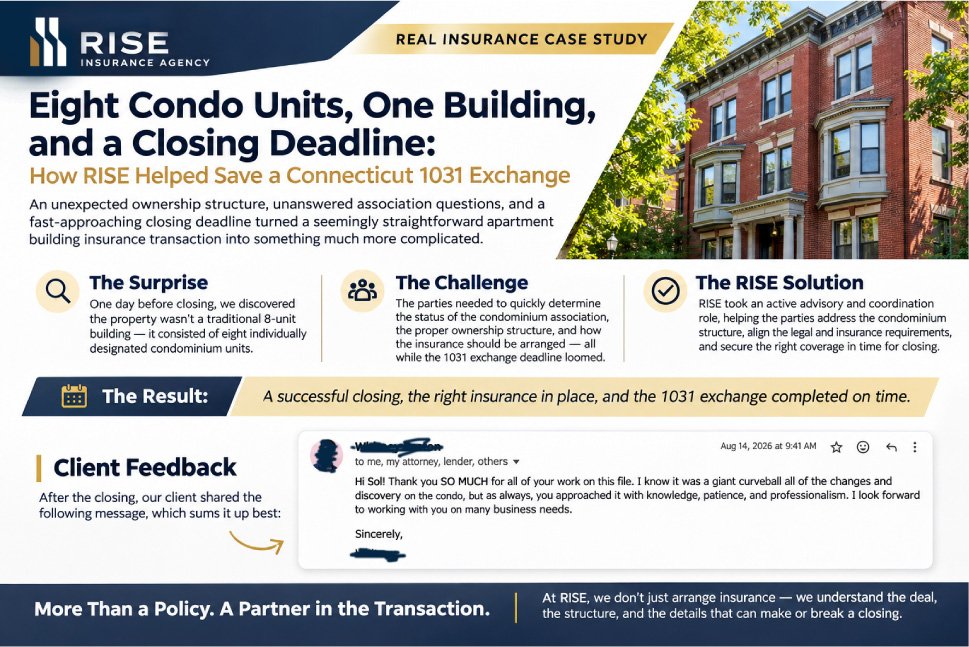
Eight Condo Units, One Building, and a Closing Deadline:
How RISE Helped Save a Connecticut 1031 Exchange
An unexpected ownership structure, unanswered association questions, and a fast-approaching closing deadline turned a seemingly straightforward apartment building insurance transaction into something much more complicated.
Everything Was Ready for Closing. Until It Wasn't.
Our client was purchasing an eight-unit residential property in Connecticut as part of a 1031 tax-deferred exchange.
The property was an attractive investment: a historic residential building with eight apartments, and a financing arrangement that required appropriate property and liability insurance to be in place before closing.
RISE Insurance Agency had been working to arrange the necessary commercial property coverage, addressing the building’s replacement cost, liability protection, and lender requirements.
Then, just one day before the scheduled closing, an unexpected discovery threatened to derail the transaction.
The property wasn’t legally structured as a conventional eight-unit apartment building. It consisted of eight individually designated condominium units.
And suddenly, what appeared to be a straightforward insurance placement became a much larger problem.
Eight Units. But Who Owned the Building?
The discovery raised an immediate series of questions.
Was there an active condominium association? If so, what was its legal name? Who controlled it? Who was responsible for the common elements of the building? And, perhaps most urgently, which legal entity should be named on the insurance policy?
These weren’t merely administrative details.
In a conventional apartment building, one owner generally owns the building and purchases insurance covering the property.
A condominium structure can be fundamentally different. Individual units may have separate legal ownership, while common elements and certain insurance responsibilities are governed by the condominium declaration and association arrangements.
Even when a single investor is purchasing all eight units, the underlying condominium structure doesn’t simply disappear.

The insurance had to reflect the actual legal structure of the property—not just how the building appeared physically or how the transaction had initially been described. Getting that distinction wrong could create serious complications in the event of a claim.
The Attorneys Were Scrambling. And the Clock Was Ticking.
With closing just hours away, multiple parties were working to establish how the transaction could proceed.
The seller’s attorney, buyer’s attorney, and lender’s attorney all had questions that needed answers.
The condominium documentation had to be examined. The status and responsibilities of the association needed clarification. And the proposed ownership arrangement had to be reconciled with the insurance requirements.
Meanwhile, our client faced another major complication.
This wasn’t an ordinary real estate purchase. It was part of a 1031 exchange, with a deadline that made postponing the closing particularly problematic.
The situation required more than simply obtaining a certificate of insurance.
It required understanding how the legal ownership structure, the lender’s requirements, and the insurance coverage all fit together.
When an Insurance Agency Becomes Part of the Solution
At RISE, we believe that arranging commercial property insurance means understanding the transaction behind the policy.
As the attorneys worked through the ownership and association questions, RISE took an active advisory and coordination role on the insurance side.
We helped identify the coverage implications of the condominium structure, raised the questions that needed to be addressed, and worked alongside the transaction participants to align the insurance arrangements with the intended ownership structure.
The solution required coordination between the legal documentation and the insurance placement.
Rather than treating the matter as someone else’s problem, we stayed engaged as the parties worked toward a structure that could satisfy the transaction’s requirements.
The attorneys addressed the legal arrangements, while RISE focused on ensuring that the insurance requirements were properly understood and incorporated into the process.
The Insurance Challenges Were Real, Too
The condominium discovery wasn’t the only insurance consideration.
This was an older Connecticut residential property, and the policy needed to address several important issues, including:
Building replacement cost
Establishing appropriate property insurance limits for a historic eight-unit building.
Named insureds and ownership interests
Making sure the policy reflected the entities and interests requiring coverage.
Condominium association considerations
Understanding how the condominium declaration and proposed association arrangements affected insurance responsibilities.
Liability protection
Addressing the relevant property ownership and premises liability exposures.
Lender requirements
Coordinating the insurance documentation needed for financing and closing.
Each of these issues mattered independently. Together, and under severe time pressure, they created a particularly demanding placement.
The Outcome:
A Successful Closing, On Time
Through close coordination, careful attention to the insurance details, and a willingness to work beyond the ordinary quote-and-bind process, the parties reached a workable resolution.
The insurance was arranged, the transaction moved forward, and our client successfully closed within the required 1031 exchange deadline.
What began as a routine eight-unit property insurance transaction became an example of why experience, responsiveness, and attention to detail matter so much in commercial real estate insurance.
The Best Part? Hearing It From Our Client.
After the closing, we received an email that made all the last-minute effort worthwhile.
“Thank you SO MUCH for all of your work on this file. I know it was a giant pain with all of the changes and miscommunication, but you were great. We closed yesterday afternoon. I look forward to working with you on future insurance needs.”
The Bigger Lesson for Real Estate Investors
A property that looks like an apartment building isn’t necessarily structured as one.
Condominium declarations, association responsibilities, separate unit ownership, and other legal arrangements can materially affect how a property should be insured.
For investors purchasing multifamily or mixed-use properties, particularly under tight financing or 1031 exchange deadlines, these questions are worth addressing early.
And when unexpected complications arise, having an insurance agency that understands the broader transaction can make a meaningful difference.
At RISE Insurance Agency, we don’t just look for a policy that fits the property.
We work to understand the property, the ownership structure, the lender’s requirements, and the transaction itself.
Because sometimes, getting the insurance right is part of getting the entire deal done.
Purchasing an Apartment
Building or Investment Property?
Whether you’re acquiring a conventional multifamily building, a mixed-use property, or a more complicated condominium-structured investment, RISE can help you navigate the insurance requirements.